[Caution: This
article is intended for those 17 and up as it contains content that may be
unsuitable for youngins, but if you are an 8-year-old in the fight game, you
done seen more than most, so just ask your Mommy and Daddy.]
getting my amateur MMA license
Tonight the smiles were grinning
at me as I were running through a slew of congratulations, pats on the back,
conversations about my maneuvers and laughter was high and repeated, and my
opponent even thanked me for the match and asked me for help with stand-up. A
couple dozen spectators in the bleachers, fighters on the card and promoters and
officials on the floor they all heaped praise; that for a minute, I thought that
I had actually won. Mofo fake illusionists. Architects of pure fantasy. It was
all believable. Even my cornermen failed to instruct me I had lost once I
exited the cage. Not a “next time, Champ! There are more fights out there.”
Had I not put these developments in
black and white I might wake up wondering in the morning “Who stole my mofo
trophy??” Nonetheless, I had been in the ring, I had been on the mat, I had
lost here before. I know the script. The Champ is not so inundated with wins
that I might embarrass myself reaching for my opponent’s trophy. I know the instinctive
actions of one who lost. “Champ, pick your head up, congratulate your opponent’s
cornermen, salute your opponent, exit the ring stage left, and for fighter’s
sake leave the damn trophy.” This is how you lose.
My amazing lost, so believable I
had not stopped smiling until I got home. Then, it truly set-in, I did great in
MMA for a boxer. I’m in physical pain
AND I lost. When you lose, you replay everything back what you could have done
right. I hate this process. But, I know the importance of losing. Yes, there is
such a thing. But, no one ever asks me what to do if I should lose. Everyone’s always
asking how to win, and yeah, that’s how it should be. But, there’s a lesson in
the roughest of all losses.
If a young fighter ever asked me
how you should feel and what you should do: Shine. You came in the arena confident,
you leave the arena confident. Everything everyone told you about your amazing loss,
believe it. You were quite awesome. But, do yourself a favor, at that juncture
of feeling awful after you lost ascend your fight game to victory: Train hard,
eat right, study yourself, study your opponent, talk with your coach and team, revisit
your lost, and make amends for the lack of experience, skill, talent, timing, strength
and/or speed. But, even if you should have no W’s in your win column, answer to
your name, “Champ”. You are of the tiniest minorities to go into that Lion’s
Den. And never forget what I tell you, youngin’.
But, me, I’m not doing any of
that shit. I’ll nurse these physical injuries and that’s about it. I got too
many W’s and too few losses…I’m going to stop at “Shine”. And then, I’ll hop
back in the ring, cage, wherever. But, you, shit, you got to work yourself
through all the various stages and win, Champion. There are no shortcuts for
those who haven’t learned the long way first or think like losers. For all practical
and non-political purposes, fighter, you are the 1%. It takes a profound mental
state to get in the ring or cage, otherwise, mofos would be doing it. But,
young fighter, it will raise your confidence level more and more in everything
that you do if applied properly. Oh, and please don’t ask me how I’m doing. Ask
me, “How much are you shining today, Champ?” “Optimal. I’m still at optimal
level”. [video soon to follow]
Get in touch and find out how to support my non-profit G.A.ME by emailing me at omowale.adewale@gmail.com.
My Next Fight
I am now training out of Gym X Boxing on Malcolm X Blvd.
May is a heavy month for me. My daily personal training sessions and boxing classes with young people don't stop while I continue to train hard for my upcoming fight in Long Island. Did I mention I'm going up from super middleweight to heavyweight.
What am I doing to increase my weight by 25lbs you say?
Lots of weight training. Hemp & chia seeds smoothies with almond or soy milk with assorted nuts seeds like cashews, pecans, sunflower seeds, etc. Avocados daily. Lots of water for the smooth processing towards the regeneration of my cells.
All presentations are interactive, fun and challenging. Be prepared!
Coming right off of that match, I have about a week to tighten up my presentation for the NOLA Veggie Fest. And then I am back and forth from US to Europe. I am expected to meet with folk in other countries (Italy and Barcelona) for promotions and tour & programming support.
What am I doing to maintain and keep my energy levels high?
I have an optimistic disposition even under fire. I will be eating bananas like nobody's business. And for more potassium because of my sensitivity to salt I aim to eat papayas as well. I don't want to get sick so I plan on eating fresh oranges, grapefruit, blackberries and blueberries. I will be juicing lemons, ginger and garlic. And I am stacking the Green Calvary! ....Chard! Spinach! Kale! Beet Greens! Collard Greens! Celery!
Tour Update April 7th - "Boxing as Veg: Tao of Plant-Based Training"
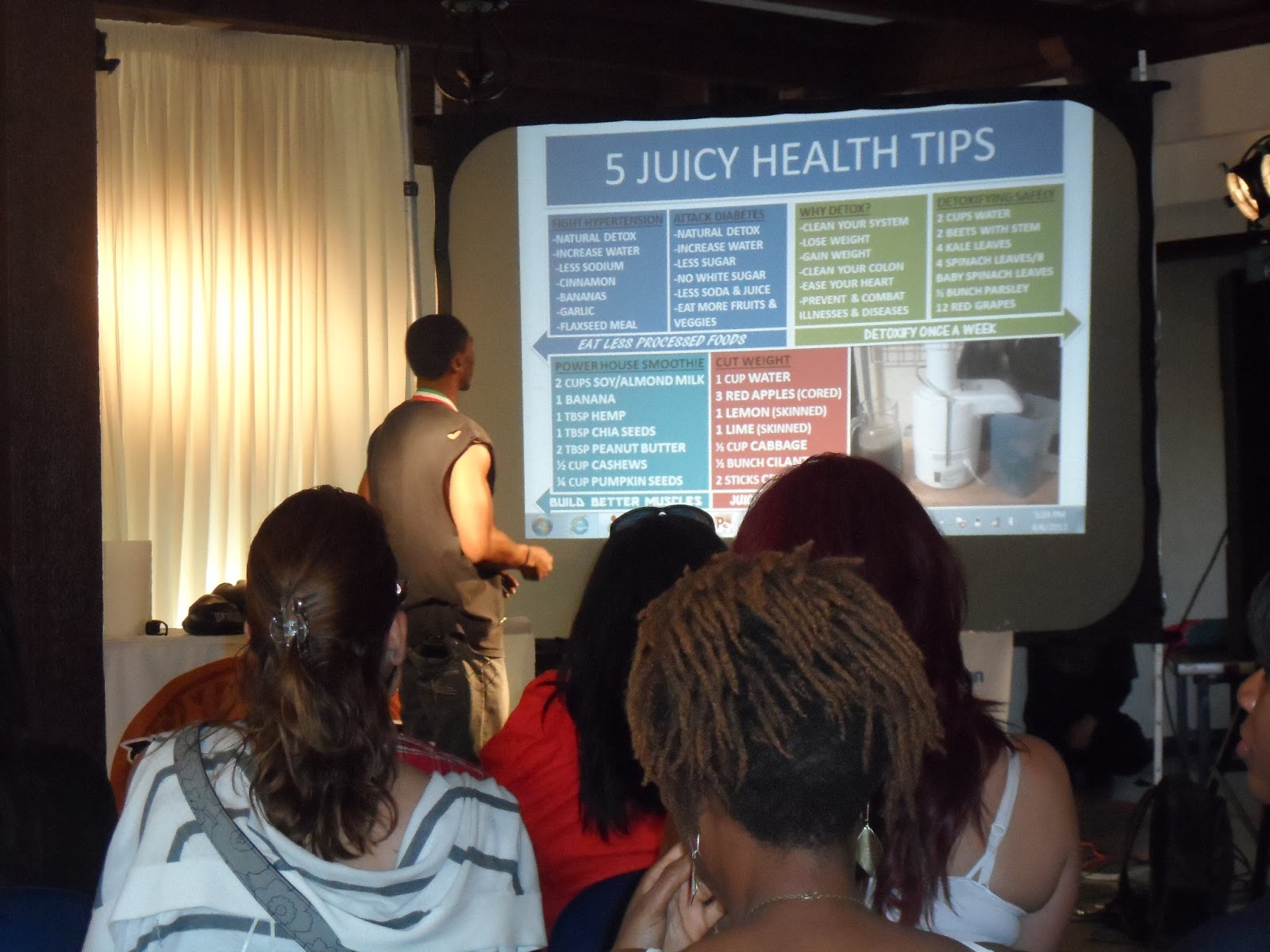
This is my first leg of the tour outside of New York City and it was in Austin, TX at the Texas Vegfest. I had an awesome first time in Austin, TX. The Texas Vegfest was done to perfection. Good food and even better people. Many already plant-based, but several were interested in becoming vegan or vegetarian. I intend to add video short. But, enjoy the pics! Feel free to share with friends and family.
I engaged people in conversation about science through a H2O demonstration. Taught folks a little about the importance of geometry in boxing discussing degrees in stance and angles for offense and defense.
Of course I had to compare plant-based nutrition plans to those that include meat.
It was nice to speak about detoxing, cutting weight and building muscle.
Tour Update March 17th - "Boxing as Veg: Tao of Plant-Based Training"
Omowale/Wale
Each stop discusses Omowale's nutritional plan and advice on going vegan with an emphasis on where to consume the most protein with this diet. The tour discusses Omowale's 20yrs as a vegetarian and his 2013 transformation to becoming a vegan. Omowale also addresses bullying, fear and aggression. And of course you'll learn boxing tips. Najee Williams assists during the demonstration as the boxer. Some stops will provide an opportunity for attendees to do abs routines at the end of the demonstration. A Q & A session will be available at the very end if time allows.
While most stops on the tour are public, some are private. All stops will feature Wale, other stops will be lucky enough to also catch young Najee in action. Email totalfitnesscp@gmail.com for more details.
This year is an exciting year
for me! In January I set my course to win the Golden Gloves, a major boxing tournament.
Last year, in my first time entering I lost in the quarterfinals. However, this
year I feel stronger and I’m more knowledgeable. I won my first match this
month by 3rd round stoppage. Yeah!. As I train for my next match I am also planning my international tour Boxing
as Veg: The Tao of Plant-Based Training.
As a vegetarian who boxer,
there’s a lot at stake in this tourney. I want to illustrate the importance of
eating healthy and exercising regularly. I want to teach our youth and adults
that monitoring our blood pressure, insulin levels, and the intake of saturated
fats is crucial to our wellness. Therefore, when the opportunity was presented
to me I decided to fly with it. I’m making stops from NYC to the Bay Area and
from India to London this year at over a dozen veg festivals.
I found a simple and practical
solution to present to the world my solution towards combating horrible eating
and terrible conditioning. I created a special way to develop young men and
women who will love to train their mind and bodies to reach their highest
potential. I
launched this tour because I had hypertension since I was 18 and now I have the
non-medicated cure. Heart disease is the number one killer in America.
I will be giving away my free pamphlet that offers everything from combating fear
to calming your aggression to lowering blood pressure and answering high
insulin levels.
OMOWALE ADEWALE “WALE”
This is Wale’s third tour
since 2005, including a leadership tour and artist empowerment tour. In 2004
and 2006 he was requested by congress to give live testimony on the poor
health of artists and poor communities at the HR 676 Universal healthcare
hearing. He has appeared in XXL and the Source and numerous publications and
media around the world on topics of health, politics and Hip-Hop. Wale is a champion
boxer who began learning at 18. Wale is a USA Boxing certified coach. As a teen
he was a former NABBA finalist and ranked 5th in the state among track and
field athletes. Wale co-founded Grassroots Artists MovEment (G.A.ME) in 2001
and developed its youth program, R.E.B.E.L through his FAR Fund/Fund for Social
Change fellowship in 2005. Before he turned 30, upon stepping onto the ground
of Africa for the first time a G.A.ME banner flapped high surrounded by a few
dozen people welcoming him to the continent. With virtually no assistance
outside of G.A.ME he has organized doctors to treat those in the US and
traveled with medicine to Nigeria. Wale managed and helped lead successful
political campaigns in NYC. Wale is certified by Family Support Systems &
ACS in foster care parenting and a Phoenix House trained youth mentor.
THE TOUR…THE PRESENTATION
The tour and
presentations for each city is entitled Boxing
as Veg: The Tao of Plant-Based Training. The presentation is divided into
three components: slides and interactive discussion, a boxing demonstration and
a 7-minute abs routine for attendees to get tough and sweaty. During the slides
and discussion, I address complete ways on how to combat hypertension and
diabetes through fruit and vegetable juicing and give a peek into my
nutritional plan and conditional regiment. The demonstration of boxing techniques
utilizes correct stance, creation of offensive angles, precision striking,
agile footwork and various punching combinations. One or two partners assist
me. Lastly, I ask volunteer attendees to grunt through a variety of abs
routines for 7-minutes.
R.E.B.E.L BOXING CLINIC
RBC is the ultimate goal for
this tour. RBC is the development of our young generation. RBC trains young
bodies and educates young minds, not to be boxing champions, but to become
champions of life. The purpose of RBC is to support the youngest and brightest
of our youth leaders work with their troubled peers. The focus is to address
fear, calm aggression and stop bullying.
THE
REACH
You have the unique
opportunity to stand on the side of good health and wellness and assist
thousands of people internationally through this amazing tour; not to mention
empower youth through long-term leadership development. As
it stands, there are 12 confirmed stops on the tour. The very first stop in the
Bronx will be led by young leaders. I will directly engage close to 5,000
people through speaking engagements, tabling, phone conversations and in-person
conversations throughout this international tour. My hope is to touch 10,000+
people. The marketing and promotional push by all the organizers connected to
each festival and conference will reach over 100,000+ peoplein the vegan, vegetarian and veg-curious arena.
Many are awaiting better health.
During the last several months,
I have been addressing fear and aggression with youth through the sport of
boxing. Although, this entire year I have been teaching boxing to various people
from Christians to Muslims, Tibetans, Eastern Europeans, Western Africans, Iraqis,
Koreans, men and women, young and old, and queers and heterosexuals, I am
especially devoted to teaching young black boys in low-income neighborhoods.
It’s not just about offering priceless lessons of discipline and self-defense.
Boxers learn how to endure to win under pressure and how to regulate their fear
and channel their aggression. These are transferable lessons in the real world.
Young boxers behave completely
different in the gym than they do anywhere else. I remember last month seeing a
young brother outside of my gym with his pants saggin’ and was amazed to see this
expression. I saw the look of shock when he pulled them up upon my request, although
it wasn’t expressed as a request. There’s a philosophy about boxing and
saggin’. Even folks outside of the ring say it, “You couldn’t defend yourself
with your pants saggin’.”
No young person has ever refused
me and I’ve asked total strangers. However, just this past month I’ve placed a personal
moratorium on asking young men to pull up their pants. While, I think the
gesture is pretty immature and somewhat disrespectful in society I’m done with
asking young people to adhere to my sensitivities. It’s completely unfair to
take my cropped picture of a young person based on their physical appearance
and my abhorrence to it and ask that they conform to what I want to view in a
public or private space.
I did not arrive at this
conclusion as a certified youth mentor, trained foster care parent, or as a fellow
in preventing violence against young people. It was not as an advocate of alternatives
in incarceration or as former executive director of a Bronx youth center.
It all happened last month
shortly after Hurricane Sandy. I found a little time to volunteer at three neighborhoods
hit extremely hard in my home city: Red Hook and Far Rockaway in Brooklyn and the
Meat Packing district in Manhattan. I found myself feeling like a young black
boy again and it was all too familiar. Although I was there to help, I was disparaged
as a thief at two of the locations. In only one incident did the sheepishness
of my denigrators conjure up enough nerve to apologize. I felt embarrassingly
young again and too black.
When I returned home, I thought
about the three times I had been stopped by the NYPD this year. One time I was
in slacks, a dress shirt, shoes and carrying a laptop bag. I can’t tell people
enough, the clothes are completely irrelevant if you’re black.
I halted my pitiful sulking for a
minute to imagine how criminalized black boys have been stolen from their
communities and sent to prisons, made suicidal or homicidal, corrupted by
gangs, labeled mentally ill, or simply murdered. An elected official in 2006 during
his re-election campaign and my campaign to gain support for alternatives to
incarceration asked me, “what about the young recidivists who get into trouble
constantly?” I thought about the disgustingly rich, the very powerful, and the
enormously resourceful and replied, “We should give our youth the same number
of chances the family of George W. Bush gave him.” The former U.S. president during
his younger years had all sorts of problems: poor school grades, run-ins with
the law including a conviction and alcohol abuse. He was president during that
time.
As a teen, I can remember incidents
with cuffs placed on my wrists and police guns pointed in my face. In each
incident I was let go in 15 minutes. Growing up in Brooklyn, before my 14th
birthday I’ve had guns pulled on me and even been shot at. Welcome to limited options,
“zero tolerance”, and no resources.
I read that youth incarceration
in NYC had dropped. I decided to take a closer look at the Mayor’s Management
Report for 2012, focusing on ACS, which began overseeing juvenile justice in
2010. According to the report, recidivism has increased every year for the past
5 years. Weapons and narcotics were up. The daily population maybe down between
2008 and 2012, but the average length of stay has remained the same. The data
showed that a 1,000+ youth had left incarceration during this 5-year-period.
That’s miraculous; because, the subsequent 5 years saw a steady increase in youth
being remanded to detention.
Ok, if it’s not obvious, the
youth have been diverted to less expensive and far safer programs embedded in
the neighborhoods of NYC. The first time I enrolled a young person into R.E.B.E.L
(Rallying, Educating & Building Effective Leadership) was in 2005. I was
not quite finished with my fellowship at that time, but the child was 15 and he
was being sent Upstate. ATI’s are hardly new. However, during that time, not
only was there no money being allocated to support ATI’s or ATD’s (alternative
to detention) the so-called liberal attorneys were not serious about ATIs or
ATDs. In 2006, I presented to the Bronx’s legal aid department. There were about
20 legal personnel present from the juvenile justice division, and not one was
a male of color. During that time, more than ninety-five percent of all youth
detained were black or Latino, the Correctional Association of NY reported.
Family court judges and probation
officers used my number, and parents pushed their attorneys to contact our
brand new ATI. Yet, in the poorest county in the State and in the borough with
the most saturation of youth detention in the city, I was completely shocked and
somewhat embarrassed that not one of those young smiling attorneys ever called
me or returned my phone call.
However, not much has changed in
youth incarceration. The Correctional Association of NY reported in 2010 black youth
were 91% of those incarcerated in OCFS juvenile prisons, 49% in need of mental
health services, and 45% are in NYC.
The same goes for stop and frisk
practices, which according to the NYCLU the NYPD has stopped and frisked
700,000 people in 2011, up from 100,000 in 2002. Ninety-percent of these stops
are of blacks and Latinos. The disproportionate stops of young black and Latino males were more
blatant and egregious as they represent 4.7% of the city’s population but
accounted for over 40% of all stops. In contrast, young white males were 3.8% of the
stops but represent 2% of the city’s population. Of the nearly 685k people
stopped in 2011, 605k was innocent. Forty-three percent of these stops were
young black and Latino males.
The Malcolm X Grassroots
Movement reported that between January 1 and June 30 of 2012, 69% of the 120
black people killed had been between 13 and 31. In both the MXGM and NYCLU
reports they cite that police use phrases such as “suspicious behavior or
appearance” or “furtive movements” as their motives for criminalizing youth.
The criminalization
of young people is something I’ve seen for years in a complete mercantile capitalist
society with the impetus being pure greed, but often race-related. Lieutenants
visit poor community districts espousing their monthly criminal reports at community
board meetings claiming to be “good guys” in our neighborhood of “bad guys”. This
is their first pit-stop in their process of reporting crime. Then they transform
young men into targeted young suspects, create quotas to harass them, produce
numbers of “arrests”, “incarcerations” and “convictions” and then develop more
reports in their requests for State and federal funding.
Not only do
poor and working class neighborhoods fund this policing strategy through their
taxes, these same tactics of criminalizing young people by identifying “bad
guys” by their clothing, behavior, and other appearances is used within our
communities. Our communities are conditioned to criminalize each other. Film
director Marlon Riggs, in his 1986 documentary “Ethnic Notions” had illustrated
during times of Jim Crow and post-slavery society had created unfathomable
stereotypes that would define black people. In one segment, switch blades were
said to be the choice of young blacks during that time. Riggs used various old clips
to describe the great depth policymakers and white media were taking to paint young
black males as too dangerous for their civil liberties. This was all part of an
argument to return blacks back to slavery. Backwards caps used to be what
switch blades were. Saggin’ pants are the new switch blades.
Where do black
youth turn? I offer them boxing. From Jack Johnson to Sugar Ray Robinson to
Muhammad Ali to today’s Peter “Kid Chocolate” Quillin young impoverished boxers
beat down by society rise to victory. Thomas Hearns, who held five world titles
in five divisions reflecting on the impact of the legendary trainer Emmanuel Stewart,
said “He wasn’t just a trainer to me, he taught me about life. Right away I
[saw] my life change. He changed a lot of people’s lives.”
Boxing is my
solace, a refuge in a harsh and often judgmental world. A young person once
said to me implicating the adults who chastise his peers for saggin’ pants, “They
don’t know how I’m doing in school.” We make judgments based on our preference
and fail to see the impact on the lives of young people.
Through boxing,
I offer them will power, resiliency, calmness, self-confidence, strength,
discipline, self-defense, regulation of aggression, a healthier body and
attitude and overall wellness. I teach boxers how to reduce their emotions and
focus on the goal ahead. Stereotypes are prevalent all around black youth, but
if they gain love of themselves they will hurdle their obstacles and smash
stereotypes. Whether they lose in the ring is inconsequential. The goal is not
to become a professional athlete, the goal is learn to overcome and astound one’s
self.
I offer their
parents the keys to connect better with them. In boxing, like all martial arts,
the student is quiet and patiently awaiting self-mastery. Students instantly
recognize the difficulty of combat when immersed in the struggle and slowly become
more receptive to learning the world around them.
In the gym,
boxers always ask me, “What do you eat if you do not eat meat?” and “How do you
‘make’ weight?” I haven’t spoken one word about the political process or how a
bill becomes a law although unbeknownst to most, that’s my more experienced
background. However, as a 19-year vegetarian I am ecstatic to teach them about
the abundance of legumes, nuts, grains and green leafy vegetables that allow me
to weigh 165lbs and bench press 300lbs. I discuss my hypertension issues in the
past tense and educate them on increasing their bananas and reducing foods high
in sodium. I teach them to get a jumpstart on fruit and vegetable juicing.
We discuss fear
and anxiety and then we go confront it in the ring with headgear, padded gloves,
mouthpiece and a protective cup with regulation. The aggression is released in
the ring. A calmness flows over you which is preceded by fatigue. Youth from
all walks of life love the feeling of being in the ring with sparring partners.
They hug their peers and partners, maybe bow, pat their heads or kiss each
other’s foreheads to show respect and gratefulness for the engagement and
encouragement.
I know what it
is to rise off the canvas and prevail. Almost four weeks ago, I won a grueling amateur boxing
match at the Fight Factory gym in Coney Island. My record improved and I won a beautiful
belt. It’s always an incredible feeling to win in the ring, but I am especially
happy about this win. I get to teach my progression. Young boxers always want to
know the details.
My opponent was
strong, fast and had a nine-year age advantage. To make matters worse, he
knocked me down in the first round with a crushing left hook that brought the
crowd to roars. The knockdown was enough time to have a conversation within
myself about my determination, composure, and confront my own fears.
In boxing,
you’re training your mind so much more than you’re conditioning your body. It’s
hard to find serenity in the midst of battle, but that’s where you need it most.
When I teach boxing I watch for errors in their form and make adjustments
consistently. There are always improvements to be made.
It’s been several
years since being a campaign manager, running a functioning organization or
being a paid political strategist. When I would discuss civics to young people,
sometimes it was like pulling teeth. With boxing, it’s effortless. They all want
to learn how to win. Such a task allows me to incorporate anything I think is necessary,
nutrition and dieting, how to throw a jab, how to defend, how to breathe when
you run, how to exercise, how to respect the power you wield, how to control
your emotions, how to respect your opponent, how to remain disciplined, how to
love, how to rebel, how to deal with defeat or rejection, how to be young and
black, how to be yourself and express yourself, how to dress the way you feel
most comfortable, how to face your fears, how to understand civics and how to
win in a society that has you pegged to lose.
I remember my first loss coming when I was 10. I was the fastest kid in elementary. Come 5th grade, a kid beats me in my final year of annual track and field snatching an undefeated title that had my name on it. I ran like a locomotive and he “glided” as I remember one P.S. 91 administrator comparing. It was close, but I hadn’t loss a race to anyone except my family. During those early years my mother would race us up and down the block in Crown Heights for fun and for contention. I learned competition through her. I never accepted losing as an option, but I later learned to respect the nature that if you lose, at least win at learning. I never hate my opponent. I embrace him/her. If I have a specialty it's learning from mistakes or the victories of my opponent. Later that year, I noticed myself attempting to take longer strides like my competitor without losing my natural speed.
Track and field isn’t like boxing. For all practical purposes, it’s more head to head. It’s not just testing your speed against your opponent’s; it’s a test of your brilliance, strategy, strength, and persistence. On May 7th of my quarterfinals match of the Golden Gloves I lost but it was a sacrifice towards gaining wisdom.
The first round made me feel invincible. I was putting punches together in bunches, simultaneously going to the head and body. The beauty was that I could tell he could box well, but I was in control for that round. Right hook to the body, right uppercut, straight left, punches I never let go are now flying from my arsenal. He didn’t buckle that round, even though he had a look of personal disgust on his face as he was still managing to lay a few good jabs and hooks of his own.
At the end of the round I was fatigued. It’s as if his corner used a ray gun on me and zapped all of my energy. Impossible! I’ve jogged for 10 miles at a time. I worked tirelessly in the gym hitting the bag thousands of times. I went back to my corner and told my trainer, “I’m tired.” I allowed my mind to be disillusioned about my fatigue. I had heard fatigue is all “mental”. In the corner, my coach praised my work in the first round, but I was gassed.
I stood up waiting for the bell pretending to be ready for the same energetic pace I set in the first round. It wasn’t 20 seconds into the round before I heard his corner, “he’s tired.” I presented myself with the worse boxing strategy in the second round concluding that I needed to finish him so I could rest.
My punches were closing the proximity between me and my slightly shorter-arm opponent altering my perception of clarity and overall boxing strategy. Behind the comfort of his defenses and in between my barrages of punches that I mistakenly assumed were wearing him down he was resting. With thoughts of capturing another victory I had my shields down and chin up. I was thinking 60% offense. 0% defense and 40% fatigue. I remember seeing Floyd Mayweather, Jr. in situations that would place anyone in panic and he would just fall into the calmest of states. I could not spell calm.
In the midst of my transition from a Pernell “Sweet Pea” Whitaker-esk boxing strategy relying on footwork and timing with feints and jabs I took an unusual and some might say peculiar turn down the uncharted course more fitting for a Julio Cesar Chavez with the up-close and personal hooks to the top and bottom. But there was no head movement like Chavez. No bobs. No weaves.
The shot that made me reel backward came in a perfect line and it was right when I had him pinned against the ropes. There was no pain. All I felt were my thoughts. “What happened?” Ninety-five percent of the damage was in not seeing it. I slid on my behind. Amazingly, I knew exactly what type of punch it was: straight right. My consciousness rebooted within milliseconds right before I hit the canvas. I felt fine. I got up. We traded punches. He was still slightly cautious, but smart. Two more standing 8-counts later the referee stopped the match. There was no protest. I was tired.
Although I didn’t feel much pain that night, blurriness bothered my vision at one point. I complained that I needed to sit down. It passed that night. My fatigue muffled the loss. I’ll wake up next morning and find out, “I actually lost?”
For several mornings I kept finding out I had lost again --My personal hellish Groundhog Day. I went from hardly turning on the television to using the motion and comedy of television to blind my loss. It made no sense to confide in anyone. I got calls. Already did hugs. Already heard from dad and mom. Spoke to boxers and I spoke to my coach. I only needed an internal conversation to help me cope.
That weekend the movie Ali came on three times. I watched it each time. I slowly began to put into perspective my amateur loss. I had no right to feel miserable. No one robbed me of my title and the best years of my life to fight. No one threatened me with imprisonment and stole food from my family’s table while attacking my character. I had a lot to be grateful for. I learned a lot from understanding Muhammad Ali’s life as a boxer.
Riiiight. If only a feel-good movie of triumph had softened the blow of losing. It was as if my mind had mocked me for thinking that the progress of redemption and revelation would be that simple. Try again. I tried sleeping and it turned into a daylight nightmare. I remember staring at the wall. Then I dreamt wide awake. I would find myself in the match again and then I’d take a step back and guard myself, snapping awake, “Damn!” I could have beaten him easily!
Strangely, I was proud of the young guy. He had held on and persevered with me. I’m sure he remembers me congratulating him inside the venue and then outside. I genuinely wanted him to win the tournament. He made it to the finals and lost in a controversial match.
I thought of why I loss: I had been complaining it was my hands hanging low. Sergio Martinez does the same thing except he guards when in close. My chin was up. Then it was also my close proximity to him. My weight was 165.5 in a 178lbs slug-fest. My fatigue! I didn’t rely on my jab.
A former undefeated professional boxer earlier this year said subsequently after losing, “Now I am a fighter.” That’s when I began to free myself mentally. But, the smoldering red lava in the pit of my belly would be cooled roughly three weeks after my loss; when one day I ran to catch a train right before the doors closed behind me. Inside, I began huffing and puffing like I was dying and I had barely run 30 yards. Disgusted with myself, I told my body to “relax!” On cue, it calmed. That’s when the idea of mental fatigue began to internalize in my mind. I smiled to myself knowing it was the breakthrough that I needed. I wanted to reach someone who had fallen and give them the same feeling of revelation. You have to experience the growth in order to learn it. No one can make you learn it by hearing or seeing. You must experience an epiphany.
With this knowledge, I often throw myself into a panic in order to test my tranquility in the eye of the storm. I have a bigger interest in using yoga and meditation in my boxing training. I am wanting longer rounds and more consecutive sparring sessions like I'm training under Ann Wolfe. I want to know how good am I now? Have I addressed all of the faults of my first amateur lost? Will I tuck in my chin? Will I stick to the game plan under pressure? Do I fight at the same weight or at a lower weight that I can manage because of my fast metabolism? My blood pressure has been maintained without medication. Can I keep it up? You must grow after losing. That is the only way you win. The hard part is over. Acceptance. Learned. It's time to train.

 My amazing lost, so believable I
had not stopped smiling until I got home. Then, it truly set-in, I did great in
MMA for a boxer. I’m in physical pain
AND I lost. When you lose, you replay everything back what you could have done
right. I hate this process. But, I know the importance of losing. Yes, there is
such a thing. But, no one ever asks me what to do if I should lose. Everyone’s always
asking how to win, and yeah, that’s how it should be. But, there’s a lesson in
the roughest of all losses.
My amazing lost, so believable I
had not stopped smiling until I got home. Then, it truly set-in, I did great in
MMA for a boxer. I’m in physical pain
AND I lost. When you lose, you replay everything back what you could have done
right. I hate this process. But, I know the importance of losing. Yes, there is
such a thing. But, no one ever asks me what to do if I should lose. Everyone’s always
asking how to win, and yeah, that’s how it should be. But, there’s a lesson in
the roughest of all losses.